
Executive Summary
Your home may be spotless.
The floors are vacuumed.
The sheets are freshly washed.
The bedroom smells clean.
Yet, hidden deep within mattresses, pillows, sofas and carpets lives an entire microscopic ecosystem that most people never see.
Dust mites.
These tiny creatures are among the most common inhabitants of homes around the world, particularly in warm and humid climates like Singapore.
The surprising part?
Dust mites don’t bite.
They don’t spread disease.
Most people never even know they’re there.
So why do scientists and indoor air specialists pay so much attention to them?
The answer lies not with the mites themselves, but with what they leave behind.
In this article, we’ll explore what dust mites are, why they thrive in our homes, why beds are their favourite habitat, and practical ways to manage them as part of a healthy indoor environment.
Quick Facts
Dust Mites at a Glance
- Dust mites are microscopic relatives of spiders and ticks.
- They are invisible to the naked eye.
- They feed mainly on tiny flakes of human skin.
- They thrive in warm, humid environments.
- Mattresses, pillows, upholstered furniture and carpets provide ideal habitats.
- The allergens associated with dust mites come primarily from their waste particles and body fragments—not from bites.
Meet Your Unseen Housemates
Imagine shrinking until you’re no bigger than the tip of a pencil.
Your mattress would no longer look like smooth fabric.
Instead, it would resemble a vast forest of fibres, tunnels and tiny spaces.
Within that landscape lives an entire microscopic community.
Dust mites move slowly through this environment, feeding on tiny flakes of skin that naturally shed from our bodies every day.
They are not invading your home.
They are simply taking advantage of a habitat humans accidentally created.
Science Minute
What Exactly Is a Dust Mite?
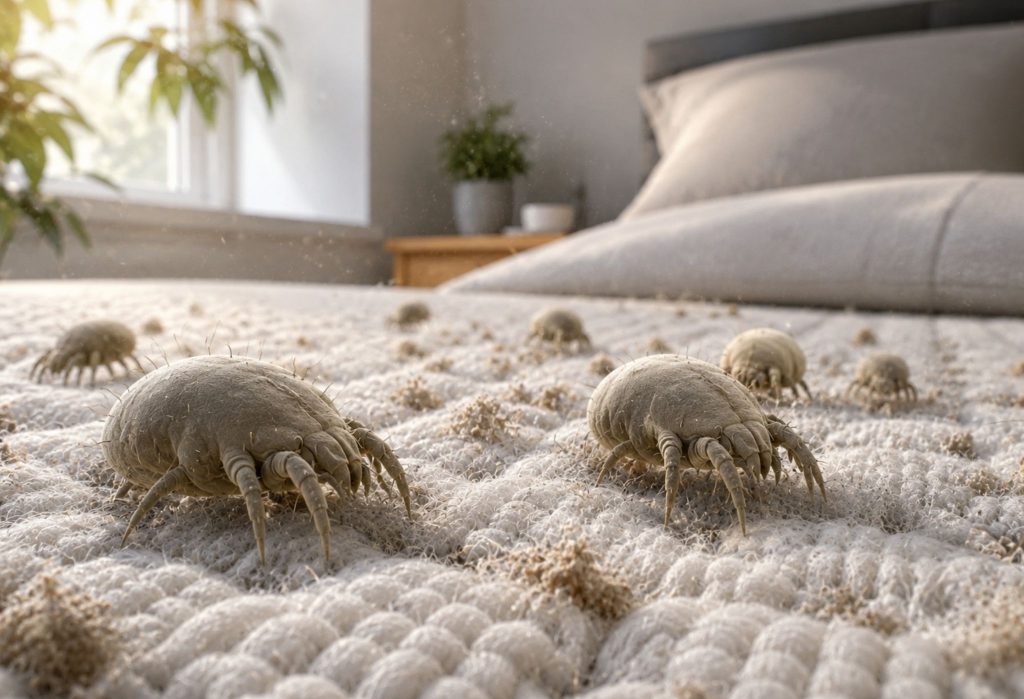
Despite their name, dust mites are not made of dust.
They are tiny living animals.
They belong to the same broad group of creatures as spiders and ticks, known as arachnids.
Most dust mites measure only about 0.2 to 0.3 millimetres in length, making them far too small to be seen clearly without magnification.
If you could place one on your fingertip, it would appear as little more than a tiny pale speck.
Although they look unusual under a microscope, dust mites have lived alongside humans for thousands of years.
Why Do Dust Mites Love Bedrooms?
If you were a dust mite, your ideal home would be surprisingly similar to a luxury hotel.
Think about what a mattress provides.
Every night it offers:
- Warmth from the human body.
- A steady supply of tiny skin flakes.
- Fabric fibres that provide shelter.
- Limited disturbance during the day.
- Moisture from normal breathing and perspiration.
For a dust mite, these conditions are close to perfect.
This is why mattresses and pillows often contain far more dust mites than hard furniture such as tables or bookshelves.
Do Dust Mites Bite?
This is one of the biggest myths surrounding dust mites.
The answer is:
No.
Dust mites do not bite people.
They are not interested in blood.
Instead, they feed mainly on microscopic flakes of skin that people naturally shed every day.
This surprises many homeowners because itchy skin is often blamed on dust mite bites.
In reality, if dust mites are involved, the concern is generally related to allergens rather than bites.
Understanding this difference helps separate fact from fiction.
The Real Reason Scientists Study Dust Mites
If dust mites don’t bite and don’t spread disease, why do indoor air scientists care about them?
The answer is that dust mites produce microscopic waste particles and eventually body fragments as part of their normal life cycle.
These tiny particles can become mixed with household dust.
When activities such as making the bed, fluffing pillows or vacuuming disturb settled dust, some of these particles may become airborne for a period of time.
For some individuals, particularly those with sensitivities, these particles are among the indoor allergens that researchers have studied extensively.
This is why discussions about dust mites often focus less on the mites themselves and more on the particles associated with them.
Why Singapore’s Climate Favors Dust Mites
Dust mites don’t drink water the way larger animals do.
Instead, they absorb moisture from the air around them.
That’s one reason humidity matters so much.
Singapore’s warm, humid climate creates favourable conditions for dust mites throughout much of the year.
Unlike countries with long, cold winters that naturally reduce mite populations, tropical environments can support dust mites more consistently unless humidity is managed.
This doesn’t mean every home has the same number of dust mites.
Ventilation, air-conditioning, humidity, furnishings and housekeeping all influence the indoor environment.
Why Do Some Homes Have More Dust Mites Than Others?
Imagine two neighbouring apartments.
Both have similar layouts.
Both are cleaned regularly.
Both have families living in them.
Yet one contains significantly more dust mites than the other.
Why?
The answer isn’t simply cleanliness.
Dust mites are influenced by the environment around them.
Just as plants grow better under certain conditions, dust mites thrive when warmth, humidity, food and shelter come together.
The Four Things Dust Mites Need
Dust mites have surprisingly modest requirements.
If these four conditions are present, they can establish healthy populations.
- Food
Dust mites don’t eat crumbs.
They don’t chew wood.
They don’t damage clothing.
Instead, they feed mainly on tiny flakes of human skin that naturally fall from our bodies every day.
Without us even noticing, we continuously provide their food source.
- Moisture
Of all the environmental factors, humidity is one of the most important.
Dust mites lose water easily.
Rather than drinking, they absorb moisture from the surrounding air.
When the air becomes too dry, they struggle to survive.
This is one reason tropical climates support larger dust mite populations than many cooler, drier regions.
- Warmth
Bedrooms are warm for several hours every night.
Our bodies gently heat mattresses, blankets and pillows while we sleep.
Combined with humidity, this creates an environment that dust mites find particularly comfortable.
- Shelter
Hard wooden tables offer very little protection.
A thick mattress, however, provides millions of tiny spaces between fibres where dust mites can live undisturbed.
The deeper they move into fabrics, the more stable their environment becomes.
Why Making Your Bed Isn’t Just About Tidiness
Most people think making the bed is simply a matter of appearance.
From an indoor air perspective, it’s also about managing moisture.
During the night, our bodies release heat and water vapour through normal breathing and perspiration.
Some of this moisture is absorbed by bedding and mattresses.
Allowing the bed to air out before covering it completely may help that moisture dissipate.
The effect varies depending on room conditions, but the principle is straightforward:
A drier sleeping environment is generally less favourable for dust mites than one that remains consistently humid.
Carpets, Curtains and Sofas
Dust mites don’t limit themselves to beds.
Any place that combines fabric, warmth and a relatively undisturbed environment can become a suitable habitat.
Common examples include:
- Upholstered sofas
- Thick carpets
- Cushions
- Fabric-covered chairs
- Heavy curtains
- Soft toys
That doesn’t mean these items are “unsafe.”
It simply means they can collect dust and retain moisture more readily than hard surfaces.
Do Dust Mites Float in the Air?
This is another common misconception.
Dust mites themselves are relatively heavy compared with microscopic airborne particles.
They spend most of their lives within fabrics rather than floating around the room.
However, activities such as:
- Shaking blankets
- Fluffing pillows
- Making the bed
- Vacuuming
- Sitting heavily on upholstered furniture
can disturb settled dust.
Some of the microscopic particles associated with dust—including dust mite allergens—may become airborne for a period before settling again.
This is why bedrooms often experience temporary increases in airborne particles during cleaning or bed-making.
Science Minute
Why Your Mattress Is Different From Your Floor
Think of your mattress as a sponge.
Not because it absorbs water like a kitchen sponge, but because it contains countless tiny spaces.
Those spaces trap skin flakes, fibres and dust over time.
A polished tile floor is very different.
Dust resting on a smooth surface is much easier to remove through regular cleaning.
The structure of soft furnishings makes them a far more complex indoor environment.
Why Vacuuming Doesn’t Remove Every Dust Mite
Many homeowners are disappointed when dust returns soon after cleaning.
The reason is simple.
A home is constantly changing.
People shed skin.
Fabric fibres wear.
Outdoor dust enters through doors and windows.
Particles settle continuously.
Vacuuming removes a significant amount of dust from accessible surfaces, but it doesn’t stop new dust from accumulating.
Nor can it easily reach every microscopic space deep inside thick mattresses or upholstered furniture.
This isn’t a failure of cleaning.
It’s simply the reality of living in an occupied home.
Did You Know?
The dust you see on a bookshelf isn’t just “dirt.”
Household dust is actually a mixture of many different materials.
Depending on the home, it may include:
- Tiny skin flakes
- Textile fibres
- Soil particles
- Outdoor particles
- Pollen
- Pet dander
- Food crumbs
- Microscopic insect fragments
- Dust mite allergens
In other words, dust is an ecosystem, not a single substance.
A Different Way to Think About Dust Mites
Many articles portray dust mites as unwanted invaders.
A more accurate way to think about them is this:
Dust mites are part of a larger indoor ecosystem.
When warmth, humidity, food and shelter come together, they simply respond to those conditions.
That means the most effective long-term strategy isn’t fighting dust mites directly.
It’s managing the environment that allows them to thrive.
Living With Dust Mites: Is Elimination Realistic?
Many people ask:
“How do I get rid of dust mites completely?”
The honest answer is:
For most homes, complete elimination is not a realistic goal.
Dust mites are part of the natural indoor environment in many parts of the world, especially in warm, humid climates.
The goal is not to create a sterile home.
The goal is to create an environment that is less favourable for dust mites and easier to keep clean.
This is an important distinction.
Indoor air scientists generally focus on managing exposure, not trying to remove every microscopic organism from a home.
Practical Ways to Reduce Dust Mite Populations
There is no single magic solution.
Instead, good indoor hygiene comes from several simple habits working together.
Wash Bedding Regularly
Bedsheets, pillowcases and duvet covers are in constant contact with our skin.
Regular washing helps remove skin flakes, dust and other particles that accumulate during everyday use.
Always follow the care instructions provided by the manufacturer for bedding and fabrics.
Keep Humidity Under Control
As we’ve seen throughout the Academy, humidity influences many aspects of indoor air quality.
Dust mites, mould and even the way some materials behave are all affected by moisture.
Managing indoor humidity doesn’t just target dust mites—it contributes to a healthier indoor environment overall.
Vacuum Soft Furnishings
Mattresses, upholstered furniture and carpets can collect dust over time.
Regular vacuuming helps reduce the amount of dust present on accessible surfaces.
Vacuums equipped with effective filtration can also help reduce the amount of fine dust released back into the room during cleaning.
Reduce Dust Reservoirs
The more surfaces that collect dust, the more places particles can accumulate.
Simple habits such as avoiding unnecessary clutter, cleaning shelves regularly and washing soft furnishings periodically all contribute to reducing dust build-up.
Maintain Good Airflow
Bedrooms that remain closed for long periods may retain more moisture than those with better air circulation.
Thoughtful ventilation and airflow help support a healthier indoor environment.
Dust Mites and Air Purifiers
This is another question that deserves a careful answer.
People often ask:
“Can an air purifier remove dust mites?”
Dust mites themselves spend most of their lives deep inside mattresses, pillows and upholstery.
They are not continuously floating around the room.
For that reason, an air purifier is not a tool for removing dust mites from your mattress.
However, indoor air is dynamic.
As beds are made, pillows are fluffed and furniture is used, some dust particles—including particles associated with dust mites—may become airborne for a period of time.
An air purifier designed to remove airborne particles may help reduce some of those suspended particles while they are in the air.
This illustrates an important principle:
Air purifiers clean the air. They do not clean mattresses.
Understanding what each tool is designed to do helps homeowners make better decisions.
Myth vs Fact
Myth
Dust mites bite people while they sleep.
Fact
Dust mites feed mainly on tiny flakes of human skin. They do not bite people.
Myth
A spotless bedroom has no dust mites.
Fact
Even very clean homes may contain dust mites because skin flakes, warmth and humidity are part of normal living.
Myth
Dust mites live only in old mattresses.
Fact
New mattresses can also become habitats over time as they are used.
Myth
Vacuuming once removes all dust mites.
Fact
Cleaning helps reduce dust, but homes are constantly receiving new dust from daily activities and the outdoor environment.
Frequently Asked Questions
Do leather sofas have dust mites?
Dust mites generally prefer soft, fibrous environments where skin flakes and moisture can accumulate. Smooth leather surfaces are usually less favourable than thick fabric upholstery, although dust can still collect in seams and cushions.
Why do hotels often feel fresher than bedrooms at home?
Many hotels have strict housekeeping routines, frequent linen changes and climate-controlled environments. Those factors can influence overall indoor cleanliness and comfort, although every building is different.
Should I replace my mattress because of dust mites?
Most mattresses do not need replacing simply because dust mites exist. Regular care, appropriate cleaning and following the manufacturer’s recommendations are generally more important than assuming replacement is necessary.
Are dust mites seasonal in Singapore?
Because Singapore has a relatively consistent tropical climate throughout the year, dust mites may remain active year-round, unlike in countries with long, cold winters.
Inside the Lab
When researchers investigate dust mites, they don’t begin by counting how many mites live in a home.
Instead, they often ask broader questions.
How humid is the bedroom?
How much dust accumulates over time?
How well is the room ventilated?
How often is bedding washed?
This reflects an important idea in indoor environmental science:
The environment shapes the ecosystem.
Change the environment, and the ecosystem changes with it.
Five Things Most People Don’t Know
- Dust mites are tiny arachnids—relatives of spiders and ticks—not insects.
- They don’t bite or drink blood.
- The particles most associated with allergies come primarily from their waste and body fragments.
- A mattress is an ecosystem containing millions of tiny spaces where dust, fibres and skin flakes accumulate over time.
- Managing humidity helps reduce conditions that favour both dust mites and mould, making it one of the most effective ways to improve the overall indoor environment.
One-Minute Summary
If you remember only one thing from this article, remember this:
Dust mites aren’t unwanted invaders that suddenly appear in your home.
They are tiny animals responding to the environment we’ve created.
The cleaner, drier and better-ventilated that environment is, the less favourable it becomes for them.
Key Takeaways
- Dust mites are microscopic arachnids that naturally inhabit many homes.
- They feed mainly on tiny flakes of human skin.
- They thrive in warm, humid environments such as mattresses and upholstered furniture.
- They do not bite people.
- Scientists are primarily interested in the allergen particles associated with dust mites rather than the mites themselves.
- Good indoor air quality depends on managing the entire indoor environment—not on relying on a single solution.
Looking Ahead
We’ve explored microscopic animals living in our homes.
Next, we’ll examine something that everyone sees—but few people truly understand:
Household dust.
What exactly is dust? Where does it come from? Why does it keep returning no matter how often we clean?
The answer is far more interesting than most people imagine.