
Executive Summary
Almost everyone has had this experience.
You clean a bookshelf.
Everything looks spotless.
The next morning, a thin layer of dust has already begun to appear.
Where did it come from?
Did it enter through the windows?
Did someone bring it inside?
Or was it there all along?
The answer is fascinating.
Household dust is not a single substance.
It is a constantly changing mixture of microscopic particles from many different sources—both inside and outside the home.
Some originate from nature.
Some come from everyday human activity.
Others are created simply by living our daily lives.
Understanding what dust is—and where it comes from—is the first step towards understanding indoor air quality itself.
Quick Facts
Household Dust at a Glance
- Dust is a mixture of many different particles.
- Most dust is too small to notice individually.
- Dust comes from both indoor and outdoor sources.
- Every home has dust, regardless of how clean it is.
- The composition of dust changes from one home to another.
Dust is constantly being created, transported and removed.
The Great Dust Mystery
Imagine sealing your home for a week.
No visitors.
No open windows.
No pets running around.
Surely there should be no new dust?
Surprisingly, dust would still appear.
Why?
Because your home is constantly producing tiny particles.
People shed skin.
Clothes release microscopic fibres.
Paper slowly wears.
Furniture experiences tiny amounts of everyday abrasion.
Even walking across the floor gently stirs particles already present.
Dust isn’t something that suddenly arrives.
It’s something that is continuously created and continuously moving.
Science Minute
Dust Is Like a Bowl of Mixed Nuts
Imagine someone hands you a bowl of mixed nuts.
At first glance, it looks like one snack.
Look closer and you’ll find almonds, cashews, peanuts, pistachios and walnuts.
Dust is much the same.
From a distance, it looks like one substance.
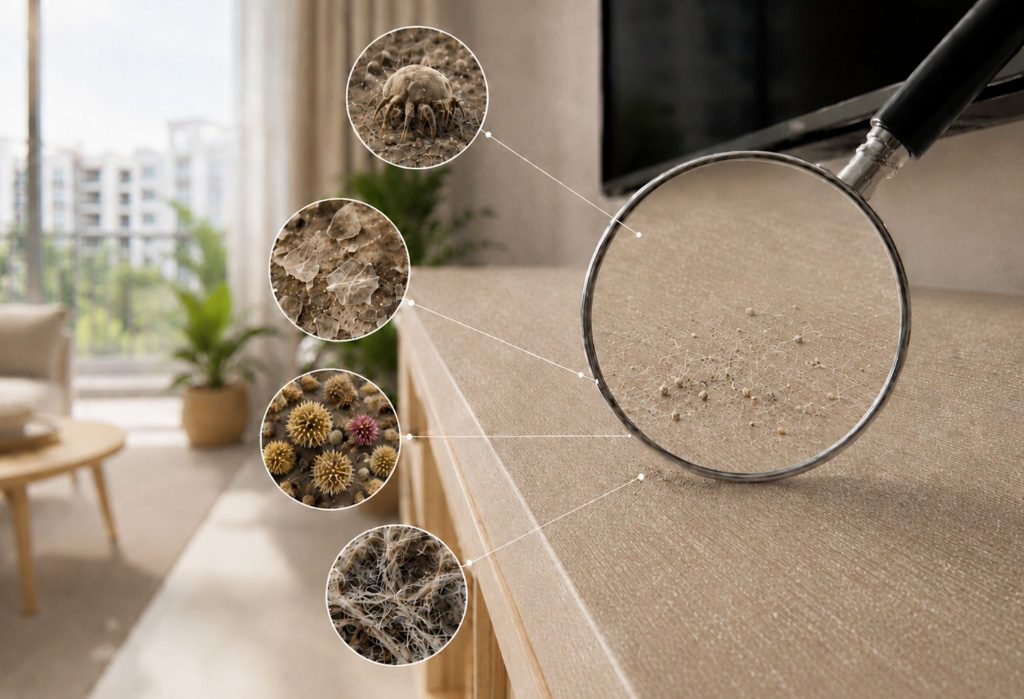
Under a microscope, however, it becomes a mixture of many different particle types.
Some are biological.
Some are mineral.
Some are synthetic.
Some come from outdoors.
Others are generated entirely inside the home.
There is no such thing as “pure household dust.”
Where Does Household Dust Come From?
Scientists generally divide household dust into two broad categories:
Indoor Sources
Many particles are produced by everyday life.
Examples include:
- Tiny flakes of human skin.
- Textile fibres from clothing and bedding.
- Carpet fibres.
- Paper fibres.
- Cooking residues.
- Hair.
- Pet dander.
- Dust mite allergens.
- Mould spores.
- Fragments from everyday wear of household materials.
The more people living in a home, the more indoor particles are typically generated.
Outdoor Sources
Even with the windows closed, outdoor particles still find ways indoors.
They may enter through:
- Open doors.
- Windows.
- Ventilation systems.
- Shoes.
- Clothing.
- Bags.
- Deliveries.
- Air leaks around buildings.
Outdoor particles can include:
- Soil.
- Pollen.
- Fine road dust.
- Sea salt.
- Plant material.
- Airborne pollution.
Your home is never completely isolated from the outdoor environment.
Every Home Has Its Own Dust Fingerprint
Here’s something many people don’t realise.
No two homes produce exactly the same dust.
A city apartment may contain more fine urban particles.
A home with pets will contain more pet-related particles.
A newly renovated home may initially contain more construction-related dust.
A house beside a busy road may receive different outdoor particles from one beside a park.
In other words,
Every home has its own unique “dust fingerprint.”
That’s one reason indoor air scientists often study buildings individually rather than assuming every home behaves the same way.
Why Does Dust Always Return?
This is perhaps the biggest mystery of all.
You dust a shelf today.
Tomorrow, it’s dusty again.
The answer is simple.
Dust never stops moving.
New particles are constantly being generated.
Older particles settle.
Walking disturbs them.
Air currents carry them elsewhere.
Some leave through ventilation.
Others enter from outdoors.
Think of dust like traffic in a city.
Cars are always arriving.
Cars are always leaving.
Even if one road becomes empty for a moment, the city itself never stops moving.
Dust behaves in much the same way.
Why Singapore’s Climate Favors Dust Mites
Dust mites don’t drink water the way larger animals do.
Instead, they absorb moisture from the air around them.
That’s one reason humidity matters so much.
Singapore’s warm, humid climate creates favourable conditions for dust mites throughout much of the year.
Unlike countries with long, cold winters that naturally reduce mite populations, tropical environments can support dust mites more consistently unless humidity is managed.
This doesn’t mean every home has the same number of dust mites.
Ventilation, air-conditioning, humidity, furnishings and housekeeping all influence the indoor environment.
Did You Know?
The largest dust particles settle quickly under gravity.
The smallest particles can remain suspended in the air for much longer before eventually settling onto surfaces.
This is one reason why cleaning surfaces alone doesn’t tell the whole story of indoor air quality.
Why Does Dust Settle on Everything?
Have you ever wondered why the top of a bookshelf becomes dusty while the side remains relatively clean?
Or why television screens, ceiling fans and picture frames seem to collect dust so quickly?
The answer lies in a combination of gravity, air movement and the size of the particles themselves.
Larger dust particles tend to settle onto horizontal surfaces under the influence of gravity.
Smaller particles remain suspended in the air for longer, moving with air currents before eventually settling—or being carried elsewhere.
This is why dust doesn’t simply fall straight down.
It drifts, circulates and gradually finds places to rest.
Dust Is Always on the Move
Many people imagine dust as something static.
In reality, dust is constantly travelling.
Everyday activities keep particles moving through your home.
Consider what happens when you:
- Walk across the floor.
- Sit on a sofa.
- Fluff a pillow.
- Open a window.
- Turn on a ceiling fan.
- Switch on the air-conditioner.
Each of these actions changes how air moves within a room.
As air moves, it can lift settled particles back into the air, where they may remain suspended for a time before settling somewhere else.
This is why dust often seems to “reappear.”
In many cases, it never truly disappeared—it simply changed location.
Science Minute
A Snow Globe Is a Good Analogy
Imagine shaking a snow globe.
At first, thousands of tiny white flakes swirl through the water.
Gradually, the flakes settle onto the bottom.
Now shake it again.
The same flakes become suspended once more.
Household dust behaves in a similar way.
Daily activities continuously “shake the snow globe” inside our homes.
Most particles eventually settle, but many are easily disturbed again.
This constant cycle of settling and resuspension is one reason dust is such a persistent feature of indoor environments.
Why Do Some Rooms Get Dustier Than Others?
Not every room behaves the same way.
A spare bedroom used only occasionally may collect dust differently from a busy living room.
Several factors influence dust accumulation:
How Often the Room Is Used
More people generally means more movement, more skin flakes and more disturbed particles.
Airflow
Rooms with stronger airflow may receive particles from other parts of the home.
At the same time, airflow can also help carry particles away.
Furnishings
Soft furnishings such as carpets, curtains and upholstered furniture tend to trap dust more readily than smooth surfaces.
Outdoor Connection
Rooms with frequently opened windows or balconies may receive more outdoor particles.
Cleaning Habits
Dust accumulation reflects not only how much dust enters a room but also how often it is removed.
Why Does Dust Look Grey?
Here’s something surprisingly few people ask.
If dust comes from so many different sources, why does it usually look grey?
The answer lies in mixing.
Imagine blending black pepper, flour, sugar, cocoa powder and finely crushed paper together.
The individual colours become much harder to distinguish.
Household dust behaves similarly.
Because it contains so many different materials in tiny amounts, the overall appearance tends to become a dull grey.
Its colour tells us very little about what it’s actually made of.
Only detailed laboratory analysis can reveal its composition.
Dust and Technology
Have you ever noticed dust building up around televisions, computer monitors or entertainment systems?
Part of the reason is simple:
Electronic devices often contain cooling fans that draw air through the equipment to remove heat.
As air passes through, dust particles may collect on vents and internal components.
This doesn’t mean electronics create dust.
Rather, they continuously interact with the air already present in the room.
Keeping ventilation openings clean can help maintain equipment performance and reduce unnecessary dust build-up.
Is Household Dust Always Harmful?
This is an important question.
The answer is:
Not necessarily.
Dust itself is simply a collection of particles.
Whether those particles are significant depends on many factors, including:
- Their size.
- Their composition.
- Their concentration.
- Whether they remain airborne or settle.
- The activities taking place in the room.
For example, a visible layer of settled dust on a bookshelf is very different from microscopic particles suspended in the air that may be inhaled.
This distinction helps explain why indoor air scientists pay close attention to both surface cleanliness and airborne particles.
Did You Know?
A beam of sunlight shining through a window can reveal countless tiny particles drifting through the air.
Those particles were already there.
The sunlight simply made them visible.
It’s a beautiful reminder that much of the indoor world exists beyond what we normally notice.
A Different Way to Think About Dust
Instead of seeing dust as “dirt,” imagine it as a diary.
Every particle tells part of the story of your home.
Some arrived from outside after yesterday’s rain.
Some came from the jumper you wore this morning.
Some came from cooking dinner.
Some settled quietly from the air while everyone was asleep.
Together, they form a constantly changing record of life inside your home.
That’s what makes household dust so fascinating to scientists—it isn’t just a nuisance.
It’s a reflection of the environment we live in every day.
Can We Ever Have a Dust-Free Home?
It’s a question almost every homeowner has wondered.
“Can I completely eliminate dust?”
The honest answer is:
No—and that’s perfectly normal.
Dust is a natural consequence of living in a home.
Every day:
- People shed skin cells.
- Clothing releases tiny fibres.
- Outdoor air brings in new particles.
- Everyday activities disturb settled dust.
- Materials slowly wear through normal use.
Even an empty, unoccupied building will gradually collect dust from the surrounding environment.
The goal isn’t perfection.
The goal is sensible management.
Cleaning vs Improving Indoor Air
People often think these are the same thing.
In reality, they’re related—but not identical.
Cleaning focuses on removing dust that has already settled onto surfaces.
Indoor air quality also considers particles that are still suspended in the air.
Imagine autumn leaves.
You can rake leaves already on the ground.
But leaves still falling from the trees are part of a different process.
Indoor particles behave similarly.
Some have already settled.
Others are still moving through the air.
Managing both gives a more complete picture of indoor air quality.
Why Dust Comes Back So Quickly After Cleaning
Many people become frustrated after spending hours cleaning, only to notice dust returning a day or two later.
This doesn’t necessarily mean the cleaning was ineffective.
Think of rainfall.
Drying the pavement after a shower doesn’t stop tomorrow’s rain.
In the same way, removing today’s dust doesn’t stop new particles from being generated tomorrow.
Every occupied home is constantly producing, receiving and redistributing particles.
Cleaning reduces what is present at that moment.
It does not stop the natural cycle.
Understanding this helps set realistic expectations.
The Relationship Between Dust and Air Purifiers
This is another topic where expectations matter.
People often ask:
“Will an air purifier stop dust from settling on my furniture?”
The answer is:
Not completely.
Here’s why.
An air purifier can only act on particles that are suspended in the air and pass through the purifier.
It cannot remove dust that has already settled on bookshelves, tables or inside drawers.
Nor can it instantly capture every airborne particle in a room.
Think of a railway station.
Passengers only pass through the ticket gates if their journey takes them there.
Likewise, airborne particles are only captured if air carrying those particles passes through the purifier.
This is why good indoor air management usually combines several approaches:
- Regular cleaning to remove settled dust.
- Ventilation where appropriate.
- Sensible humidity management.
- Air purification to reduce airborne particles.
Each approach plays a different role.
Dust Isn’t the Enemy
This may sound surprising.
Dust itself is not an enemy to be defeated.
It is simply part of the environment created by everyday life.
The challenge arises when dust accumulates excessively or contains particles that affect comfort, cleanliness or indoor air quality.
Thinking about dust in this balanced way helps avoid unnecessary anxiety while encouraging practical habits.
Myth vs Fact
Myth
Dust is mostly dirt from outside.
Fact
Household dust usually contains a mixture of particles from both indoor and outdoor sources.
Myth
If I clean every day, I shouldn’t see any dust.
Fact
New particles are constantly being generated and entering the home, so some dust will always return.
Myth
Large dust particles and fine airborne particles behave the same way.
Fact
Larger particles settle relatively quickly, while finer particles may remain suspended in the air for much longer.
Myth
Seeing dust floating in sunlight means the air is unusually dirty.
Fact
The sunlight is simply making particles visible that are often present but difficult to see under normal lighting.
Frequently Asked Questions
Why does black furniture seem dustier than white furniture?
Dust is often more noticeable because of the contrast in colour. The amount of dust may be similar; it’s simply easier to see.
Why does dust collect on top of cupboards?
Horizontal surfaces allow settling particles to accumulate over time, especially in areas that are cleaned less frequently.
Does opening windows always increase dust?
Opening windows may allow outdoor particles to enter, but it can also improve ventilation. The overall effect depends on factors such as outdoor air quality, weather conditions and the surrounding environment.
Is all dust the same?
No.
The composition of dust varies from one home to another depending on occupants, furnishings, outdoor surroundings, pets, activities and many other factors.
Inside the Lab
When researchers analyse household dust, they don’t simply ask:
“How much dust is there?”
They ask:
“What is the dust made of?”
A laboratory sample may contain:
- Mineral particles.
- Textile fibres.
- Biological material.
- Pollen.
- Mould spores.
- Dust mite allergens.
- Outdoor pollution particles.
Understanding the composition helps scientists learn much more about the indoor environment than simply measuring the amount of dust alone.
In other words,
Dust tells a story.
Five Things Most People Don’t Know
- Household dust is a mixture of many different particles rather than a single substance.
- Every home has its own unique “dust fingerprint.”
- Many dust particles are produced inside the home through completely normal daily activities.
- Fine particles and larger particles behave very differently in the air.
- Dust is continuously being created, transported, removed and replaced—it is part of a constantly changing indoor environment.
One-Minute Summary
If you remember only one thing from this article, remember this:
Dust is not simply dirt.
It is a constantly changing mixture of particles that reflects the way we live, the materials around us and the environment outside our homes.
Understanding dust helps us understand indoor air itself.
Key Takeaways
- Household dust is a dynamic mixture of indoor and outdoor particles.
- Every home has a unique combination of dust sources.
- Dust is continuously generated and redistributed through normal daily activities.
- Cleaning removes settled dust, while indoor air quality also considers particles that remain airborne.
- No single solution can eliminate dust completely; good indoor air quality comes from combining sensible cleaning, ventilation, moisture management and, where appropriate, air purification.
Looking Ahead
So far, we’ve explored particles generated inside our homes.
In the next article, we’ll look outside.
How does outdoor air enter our homes?
Can closing every window keep pollution out? Why do some homes feel fresh while others feel stuffy? And what really happens when outdoor air meets indoor air?
We’ll explore the fascinating science of ventilation and air exchange—one of the most important, and often misunderstood, aspects of indoor air quality.