
Executive Summary
If you’ve ever shared your home with a dog or cat, you’ve probably noticed pet hair on your clothes, furniture or car seats.
Many people assume that the hair itself is what causes allergies.
Surprisingly, that’s not usually the whole story.
Scientists have long known that pet hair and pet dander are not the same thing.
Pet hair is easy to see.
Pet dander is often invisible.
Understanding the difference is important because it helps explain why some people experience allergy symptoms even in homes that appear perfectly clean—or even in places where the pet isn’t present.
In this article, we’ll explore what pet dander really is, how it moves through a home, and practical ways to manage indoor air quality while continuing to enjoy life with pets.
Quick Facts
Pet Dander at a Glance
- Pet dander is not the same as pet hair.
- Dander consists of tiny flakes of skin shed naturally by animals.
- Proteins associated with pet dander, saliva and urine are often the substances linked to allergic reactions in sensitive individuals.
- Pet-related particles can settle on furniture, clothing and household dust.
Good housekeeping, ventilation and appropriate air cleaning can all contribute to managing indoor air quality in homes with pets.
The Great Pet Hair Myth
Imagine visiting two homes.
In the first, a large dog greets you at the door.
Dog hair is visible on the sofa.
In the second, there isn’t a single pet in sight.
The house looks spotless.
Yet someone with pet allergies may react in either home.
How is that possible?
The answer lies in understanding the difference between what we see and what we don’t see.
Pet hair is only one part of the picture.
Many of the particles associated with pet allergies are microscopic and can remain in the indoor environment even after visible hair has been removed.
Science Minute
What Is Pet Dander?
Pet dander refers to tiny flakes of skin that animals naturally shed as part of the normal renewal of their skin.
Just as humans constantly shed microscopic skin cells, dogs, cats and many other furry animals do the same.
These flakes are usually far too small to notice individually.
Researchers have also identified proteins produced by animals—in their skin, saliva and urine—that can attach to these tiny particles and contribute to allergic reactions in susceptible individuals.
This is why discussions about pet allergies often focus on pet allergens, rather than simply pet hair.
Why Pet Hair Isn’t the Whole Story
Pet hair is certainly noticeable.
It collects on clothes.
It gathers under furniture.
It seems to appear moments after cleaning.
However, hair itself is relatively large compared with many microscopic particles found indoors.
Think of pet hair as a delivery vehicle.
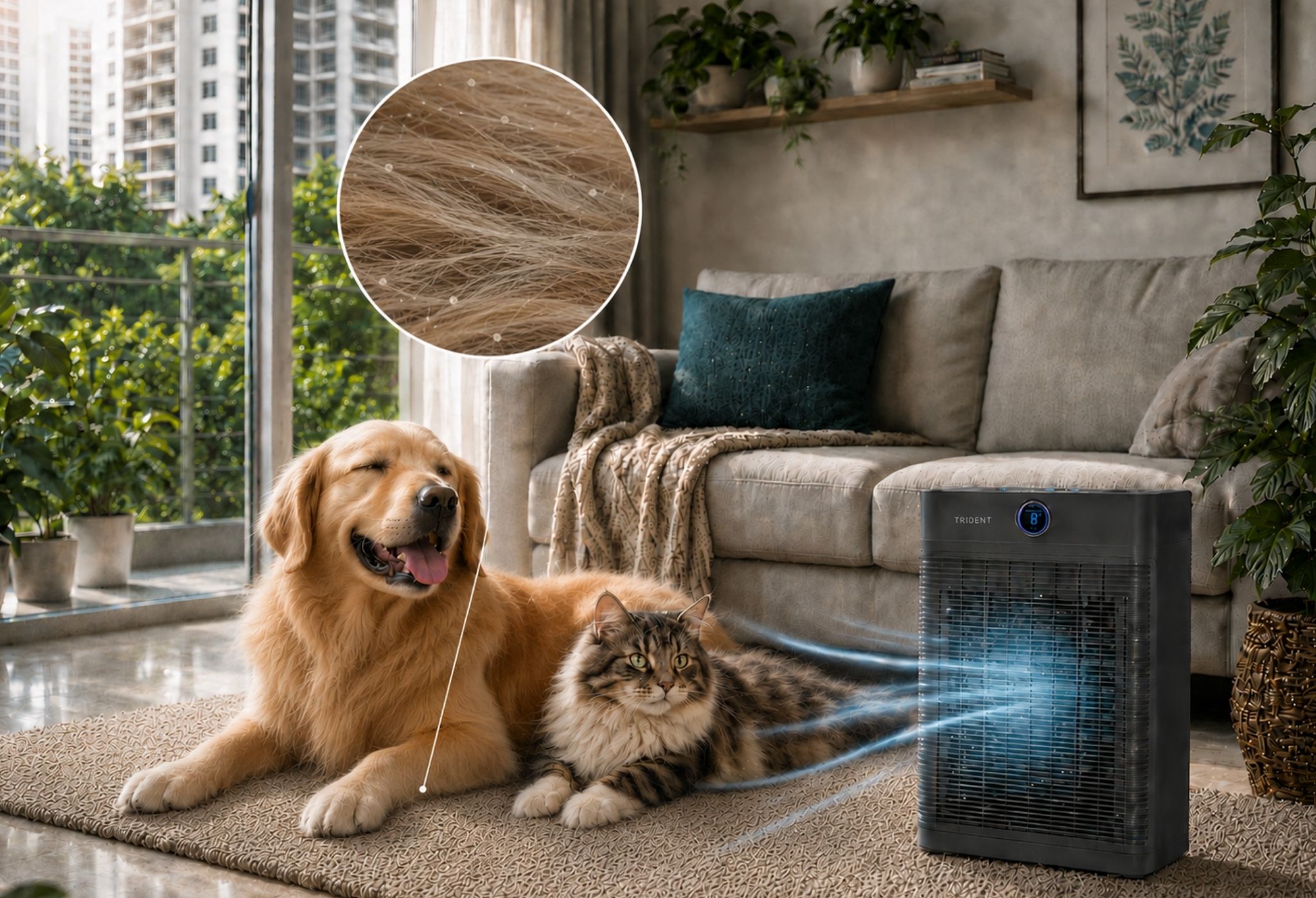
Tiny skin flakes and allergen-containing particles can settle on or around the hair, but the visible strand isn’t necessarily the main reason someone experiences allergy symptoms.
That’s why removing loose hair alone doesn’t eliminate all pet-related particles from a home.
Living Together
One of the wonderful things about pets is that they become part of the family.
They share our living rooms.
They sleep beside us.
They greet us at the door after work.
Naturally, they also become part of the home’s indoor environment.
As pets move through the house, they shed hair, tiny skin flakes and other biological particles.
These settle into the same indoor ecosystem we’ve explored throughout this Academy—mixing with household dust, circulating with air movement and gradually becoming part of everyday indoor life.
Did You Know?
Pet-related particles can travel on clothing.
This is one reason pet allergens may sometimes be detected in places where no pets live, such as offices, schools or public transport.
The particles are carried there by people rather than by the animals themselves.
How Pet-Related Particles Move Around the Home
Imagine a dog shaking itself after coming in from a walk.
Or a cat jumping onto the sofa before curling up for a nap.
Each movement releases tiny particles into the surrounding environment.
Some settle quickly onto nearby surfaces.
Others become mixed with household dust.
Still others may remain suspended in the air for a period before eventually settling.
The movement of these particles depends on many factors, including:
- Airflow.
- Human activity.
- Cleaning habits.
- The type of flooring and furniture.
- The size and weight of the particles.
Just like the dust we explored in the previous article, pet-related particles are constantly moving through the home.
Why Bedrooms Matter
Many pet owners enjoy sleeping with their pets.
For many families, this is part of the special bond they share.
From an indoor air perspective, however, it’s worth recognising that bedrooms are places where we spend around one-third of our lives.
When pets regularly spend time on beds, pillows or upholstered furniture, pet hair, skin flakes and other particles may gradually accumulate in those areas.
This doesn’t mean pets should never enter the bedroom.
It simply means that sleeping areas deserve particular attention when managing indoor air quality.
Every household can make choices that best suit their lifestyle and preferences.
Science Minute
Why Soft Furnishings Collect More Pet Particles
Think about trying to remove sand from two different surfaces.
One is a smooth glass table.
The other is a thick wool blanket.
The sand brushes off the glass quite easily.
The blanket holds onto the grains much more tightly.
Soft furnishings behave in a similar way.
Their fibres create countless tiny spaces where hair, dust and microscopic particles can become trapped.
That’s why sofas, carpets, pet beds and curtains often require more regular cleaning than smooth, hard surfaces.
Do So-Called “Hypoallergenic” Pets Exist?
This is one of the most common questions asked by prospective pet owners.
The answer is a little more complicated than many people expect.
Some breeds may shed less hair than others.
However, because allergens are associated with proteins found in skin, saliva and other biological materials—not just hair—no breed can be guaranteed to be completely free of allergens.
Individual experiences also vary.
Someone may react differently to one animal than another, even within the same breed.
For people with significant allergies, it’s wise to spend time with an animal before making the long-term commitment of bringing it home.
Why Cleaning Never Seems to End
Have you ever vacuumed your home, only to find pet hair appearing again the next day?
You’re not imagining it.
Pets naturally shed hair and skin as part of their normal biology.
As long as a pet lives in the home, new particles will continue to be introduced.
That’s why indoor air management isn’t about achieving perfection.
It’s about keeping everyday accumulation under control through regular housekeeping and sensible routines.
The same principle applies to household dust, which is constantly being created and redistributed.
Did You Know?
Cats spend a significant part of their waking hours grooming themselves.
During grooming, saliva is transferred onto their fur.
As the fur dries and tiny particles become part of the indoor environment, proteins associated with saliva may also become distributed around the home.
This is one reason why discussions about cat allergies extend beyond fur alone.
A Home Shared by Everyone
When we think about indoor air, it’s easy to focus only on the building.
But homes are shaped by the people—and animals—who live in them.
Every family is different.
Some have energetic dogs.
Some have indoor cats.
Others keep rabbits, guinea pigs or birds.
Each household creates its own unique indoor environment.
Just as we described every home having its own dust fingerprint, every pet-owning household develops its own indoor air fingerprint, influenced by the number of pets, their habits, the home’s design and everyday routines.
There is no single “perfect” home.
Only different environments that can be understood and managed thoughtfully.
Living Comfortably With Pets
For many people, pets are much more than animals.
They are companions.
They become part of the family.
They greet us after work, sit beside us during quiet evenings and share our homes for many years.
Good indoor air quality doesn’t mean giving up those relationships.
Instead, it means understanding how to create an indoor environment that is comfortable for everyone—both people and pets.
Fortunately, many simple habits can make a meaningful difference.
Practical Ways to Manage Pet-Related Particles
Rather than relying on a single solution, think about managing the entire indoor environment.
Groom Pets Regularly
Regular grooming can help reduce loose hair before it spreads throughout the home.
The best grooming routine depends on the type of animal and its coat.
Following advice from your veterinarian or professional groomer can help ensure grooming is appropriate for your pet.
Clean Areas Where Pets Spend Time
Pet beds, blankets and favourite resting places naturally collect hair, skin flakes and dust over time.
Regular cleaning helps prevent unnecessary build-up.
Vacuum Soft Furnishings
Sofas, carpets and upholstered chairs can trap pet-related particles.
Routine vacuuming helps remove hair and settled dust from accessible surfaces.
Vacuums with effective filtration may also reduce the amount of fine dust released back into the room during cleaning.
Encourage Good Ventilation
Fresh air exchange helps dilute many indoor pollutants, including those associated with everyday living.
As discussed in the previous article, the best approach depends on outdoor air quality and the design of the home.
Maintain Good Overall Housekeeping
Remember that pet-related particles become part of the broader indoor ecosystem.
Managing dust, humidity and ventilation benefits the entire indoor environment—not just pet owners.
Pet Dander and Air Purifiers
This is one of the questions we hear most often.
“Will an air purifier remove pet dander?”
The answer requires a little explanation.
Pet hair that has already settled on the floor or sofa won’t be removed by an air purifier.
However, some microscopic pet-related particles may become airborne during everyday activities, such as:
- A dog shaking its coat.
- A cat jumping onto a chair.
- Brushing a pet.
- Vacuuming.
- Making the bed after a pet has been sleeping on it.
When these particles are suspended in the air, an air purifier designed to capture airborne particles may help reduce them as air passes through the device.
This highlights an important principle we’ve seen throughout the Academy:
Air purifiers clean the air. They don’t replace cleaning, grooming or good housekeeping.
Each strategy plays a different role.
Myth vs Fact
Myth
Pet hair is the same as pet dander.
Fact
Pet hair and pet dander are different. Dander consists of tiny flakes of skin, and proteins associated with skin, saliva and urine are often linked to allergic reactions in sensitive individuals.
Myth
If I can’t see pet hair, there are no pet-related particles.
Fact
Many pet-related particles are microscopic and cannot be seen with the naked eye.
Myth
Bathing a pet once solves the problem.
Fact
Pets naturally continue to shed hair and skin as part of normal life, so ongoing care is more effective than one-off measures.
Myth
A clean home has no pet allergens.
Fact
Even well-maintained homes with pets will contain some pet-related particles. The goal is sensible management, not complete elimination.
Frequently Asked Questions
Should pets be allowed on the bed?
This is a personal decision.
From an indoor air perspective, allowing pets onto beds may increase the amount of pet hair and skin flakes that accumulate in bedding. Each household should balance this consideration with personal preference and the needs of family members.
Are short-haired pets better for allergies?
Not necessarily.
Hair length and the amount of allergen associated with an animal are not the same thing. Individual responses vary considerably.
Do birds produce indoor particles too?
Yes.
Birds naturally produce feathers, tiny skin particles and feather dust. Like other pets, they contribute their own unique particles to the indoor environment.
Can pet allergens remain after a pet has left the home?
Some pet-related particles can remain in household dust and soft furnishings for some time. Thorough cleaning and normal household maintenance help reduce these particles over time.
Inside the Lab
When researchers study homes with pets, they don’t simply ask:
“Is there a dog or cat?”
Instead, they look at the whole picture.
How many pets live in the home?
Where do they spend most of their time?
What types of flooring and furniture are present?
How is the home ventilated?
How often are fabrics cleaned?
This systems-based approach reflects a central principle of indoor environmental science:
The indoor environment is shaped by habits as much as by buildings.
Five Things Most People Don’t Know
- Pet dander is not the same as pet hair.
- Proteins associated with skin, saliva and urine are often more important than visible hair when discussing pet allergies.
- Pet-related particles can travel on clothing and be found in places where no pets live.
- Soft furnishings tend to collect more pet-related particles than smooth, hard surfaces.
- Good indoor air quality in homes with pets comes from combining housekeeping, ventilation, sensible humidity management and, where appropriate, air purification.
One-Minute Summary
If you remember only one thing from this article, remember this:
Living with pets and maintaining good indoor air quality are not opposing goals.
Pet-related particles are simply one part of the indoor ecosystem.
Understanding how they behave allows homeowners to manage them sensibly while continuing to enjoy the companionship that pets bring.
Key Takeaways
- Pet dander and pet hair are different.
- Pet-related particles include skin flakes and proteins associated with skin, saliva and urine.
- These particles can settle into dust, soft furnishings and bedding, or become airborne during everyday activities.
- Regular grooming, cleaning and good ventilation all contribute to managing indoor air quality.
- Air purifiers may help reduce airborne pet-related particles but do not replace routine housekeeping.
Looking Ahead
We’ve explored pets that share our homes.
Next, we’ll turn our attention to something that often enters from outside:
Pollen.
Why do some people experience seasonal allergies while others don’t? How do microscopic pollen grains travel such remarkable distances? And what role does pollen play in the air inside our homes?
We’ll explore the remarkable journey of one of nature’s smallest travellers.